
The site was occupied as early as the Neolithic period. Various finds, including a polished stone axe, pottery shards, and a Gallic coin, attest to its use during this time. The discovery of a stone millstone and various fragments of amphorae and Roman tiles on the terraces south and east of the castle confirms the presence of a Gallo-Roman settlement in the 1st century BC.
A few pottery shards prove that the site was still well-used during the Early Middle Ages. In 842, Peyrepertuse is first mentioned in texts under the name Pago Petrepertuse; its name comes from the Latin Petra Pertusa (the pierced stone). Thanks to its defensive advantages, it became an administrative center at a time when power was heavily militarized. It was part of the County of Razès, a Carolingian pagus.
In 1021, Peyrepertuse was a possession of the Count of Besalú and was entrusted to a castellan who would give rise to the noble family of Peyrepertuse . From the beginning of the 11th century, the Peyrepertuse fortified settlement was under the control of Narbonne and then Barcelona. An initial feudal castle, comprising a defensive structure and a 12th-century church, was built there. It was the possession of the noble family of Peyrepertuse , who controlled the entire western part of the territory. In 1155, Béranger de Peyrepertuse was a vassal of Lord Raymond, Count of Barcelona and Prince of Aragon.
During the Albigensian Crusade, William of Peyrepertuse surrendered without a fight to Simon de Montfort on May 22, 1217. Seven years later, William was excommunicated by the Archbishop of Narbonne for failing to honor his commitments to the King. He joined Raymond Trencavel's Albigensian revolt around 1240 but submitted definitively on November 16 of the same year. The castle became a royal fortress in 1239 when Louis IX purchased it from Nunyo Sanche, regent of the Kingdom of Aragon.

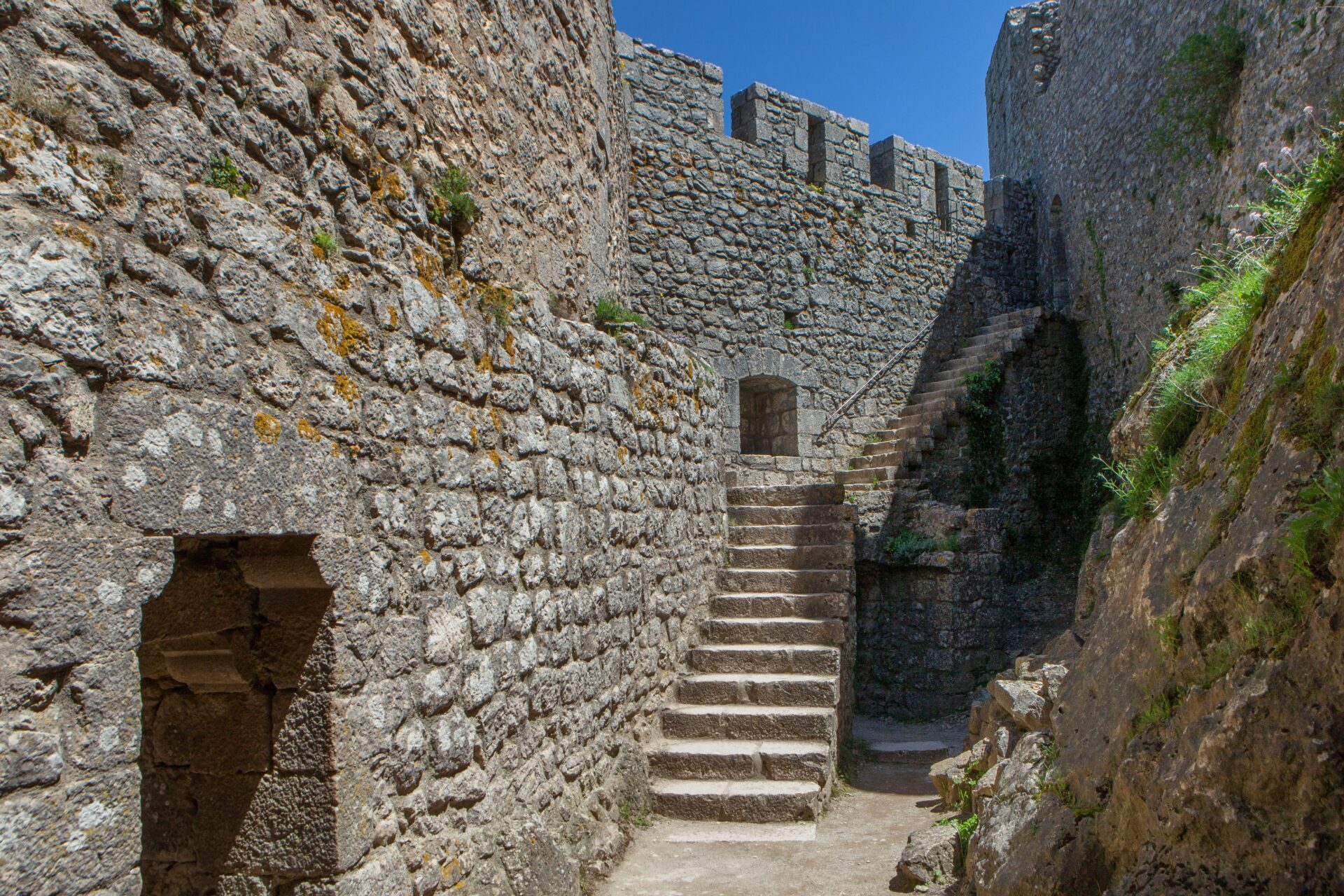
After the Barons' Crusade, followed by the royal crusade in 1226, the Château de Peyrepertuse became a Royal Fortress in 1258 with the Treaty of Corbeil. The construction of the lower, triangular enclosure dates from the mid-13th century. In 1242, Louis IX ordered the construction of a staircase carved into the rock.
Since its construction, the fortress has had the function of ensuring control of the territory which was heretical and dissident in relation to the king of France, and of facing the king of Aragon, who is an enemy power.
From then on, Louis IX undertook major construction projects. In 1242, the king ordered the construction of a staircase to reach the upper part of the square and had the San Jordy (Saint George) keep built in 1250-1251. At the same time, he renovated the old keep and the church. In 1285, during the war with Aragon, Peyrepertuse served as a residence for the fleeing notables of Perpignan . In 1542, the castle was seized by Jean de Graves, Lord of Sérignan, in the name of the Reformation, but it was quickly liberated and the perpetrators executed.
Despite the Treaty of the Pyrenees in 1659, which pushed the border further south, it retained a small royal garrison until the early days of the French Revolution when it was definitively abandoned.

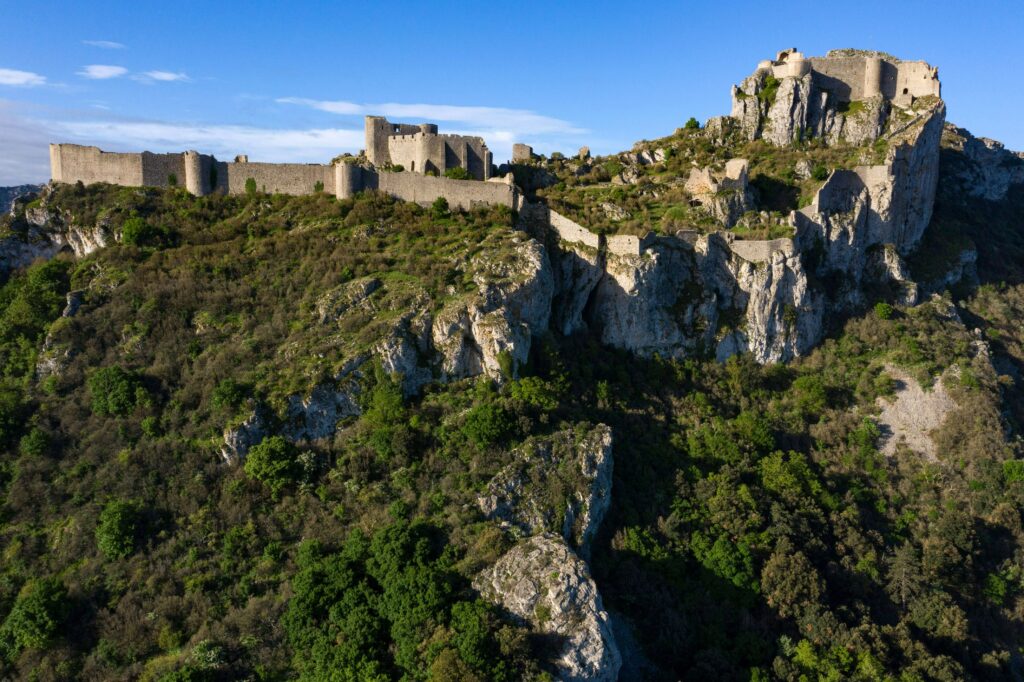
Perched majestically on the steep peaks of the Corbières, the Château de Peyrepertuse rises like an immemorial guardian of medieval history. A centuries-old witness to feudal struggles and chivalric epics, its imposing walls tell a story steeped in emotion and mystery.
Dominating the surrounding valleys, this jewel of Occitan military architecture offers a breathtaking panorama, where wild nature blends with the human imprint. Through its imposing towers and vertiginous ramparts, every stone resonates with a glorious past, inviting visitors to delve into an era where legends come to life. At Peyrepertuse , time seems suspended, offering adventurous souls an open door to medieval eternity.
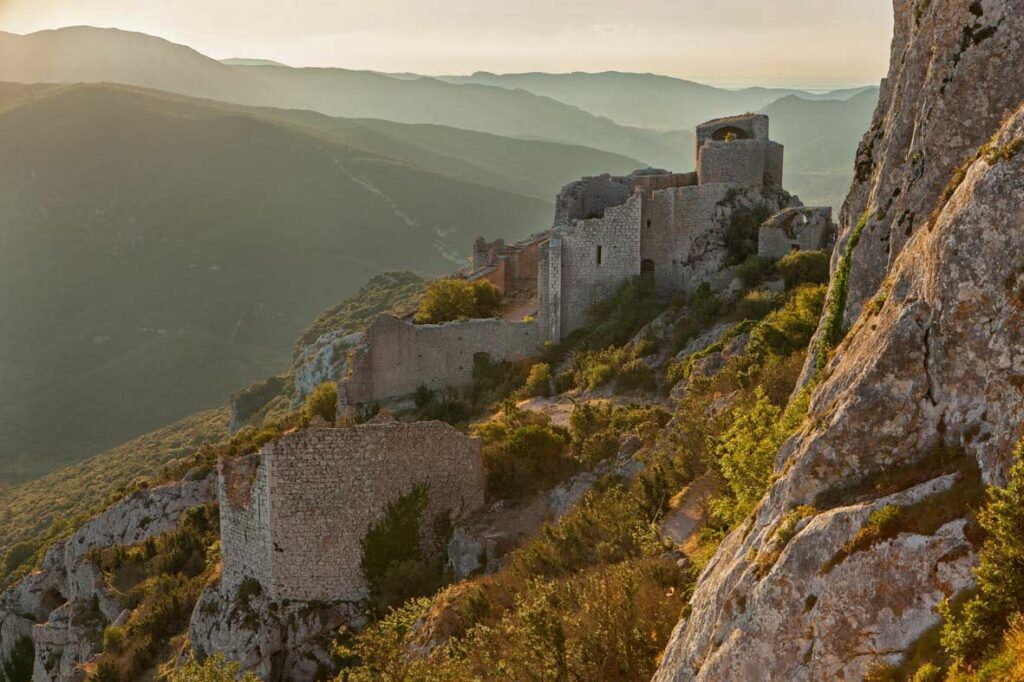
From a strategic point of view, the castle dominates the Corbières region, and within its field of vision are the Château de Quéribus, the Pech de Bugarach, Mont Tauch, and, on a clear day, a view of the Mediterranean Sea, some 40 km away. Crowning the rocky ridge of the Roc de Sagnes, the entire site forms a veritable cirque of mountains enclosed by the Roc de Sagnes (848 m), the Sarrat Pounchu (672 m) and the Quille (935 m).
Hugging its limestone cliff, the fortress of Peyrepertuse stretches for approximately 300 meters. It rises to a height of 800 meters, overlooking an exceptional landscape. Surrounded by magnificent, wild scenery , a blend of scrubland and deciduous woods, a visit to this magnificent fortress is a spectacular and enriching experience.
The municipality is located within the scope of the Mountain Law.
The flora and fauna are remarkable enough that two ZNIEFFs (natural zones of ecological, faunistic and floristic interest) have been demarcated: ZNIEFF No. 2000-10 and No. 2000-0001. ZNIEFFs do not entail protective measures: they indicate and list areas of special interest.
The municipality is included in the NATURA 2000 perimeter.
It has an Urban and Landscape Architectural Heritage Protection Zone (ZPPAUP) thanks to consultation and involvement of the population.
The municipality is part of the perimeter of the Mixed Syndicate of the Corbières – Fenouillèdes Regional Natural Park.
It is part of the listed site of Pech de Bugarach and the northern ridge of the Fenouillèdes syncline by Ministerial Decree of February 14, 2017.
On March 19th, the Château de Peyrepertuse was classified as a Historical Monument .
On March 6th, the area surrounding the Château de Peyrepertuse was registered as a protected site . A 500-meter easement extends from there.
February 14, Classification as natural sites by the Ministry of the Environment
The scientific committee has chosen to select the Château de Peyrepertuse and propose its inclusion on the prestigious list of monuments inscribed on UNESCO's World Heritage List. Peyrepertuse is one of seven castles, along with the Cité de Carcassonne, that have embarked on the path to UNESCO World Heritage status as a "serial property".
The architectural heritage of the town includes a building protected as a historical monument: the Château de Peyrepertuse , a site classified in 1908.